
This post may contain affiliate links. Please see my full disclosure and privacy policy for details.
For me crochet and colour always go hand in hand. I never think about making anything without first contemplating its colour scheme. Even if it’s going to be in a solid colour or perhaps just two, the choices we make for our crochet colours are so important!
However, they can also feel super overwhelming and intimidating. This is where the crochet colour wheel and learning a bit about colour theory can really help! Let me share with you my system that I use for every project I design 🙂
Table of Contents
Why Does Colour Choice Matter In Crochet?
Our choice of crochet colours are important for plenty of reasons but my main thoughts are:
- Will the colour/s work for the finished item? i.e. where will it live? who will wear it?
- Do I like the colour/s? There’s no point in making something that you really don’t like (even if it’s for someone else!) as you’ll spend many hours working with these colours!
Let’s dig into colour theory and find out how understanding it can give us the tools to confidently choose yarn colours for every crochet project!

Summarise and Save For Later:
Colour Theory For Crochet – How Does It Make You Feel?
The way that colours make you feel is of the utmost importance to me. If you are spending 50 hours working on a blanket in a colour scheme that makes you feel tense or uncomfy then what’s the point?!
It’s vital that you work with shades that make you feel all sorts of happy and lovely things like calm, warm, cosy and safe, but they can sound rather boring too can’t they?
It’s also great to find shades that make you feel excited and challenged! They are awesome to work with.
But, firstly, how do we understand these colour combinations? And perhaps more importantly, how do we put them together to work for projects?
That’s where colour theory comes in!
Where does colour theory come from?
Sir Issac Newton established colour theory back in 1666 and identified that we as humans perceive colours rather than see them the same. He invented the colour wheel that we can use today to work out how colours work together.

Ready to learn more?
Join me for my crochet colour course!
A complete interactive online course to find YOUR confidence with colour.
The ultimate way to discover, explore and understand colour so that you can confidently use it in every project!
The principles of colour theory
Before you get too worried – this isn’t a heavy science lesson! Quite the opposite in fact. In order to figure out when and how to use colours we just need to have a look at where they come from and how they work together.
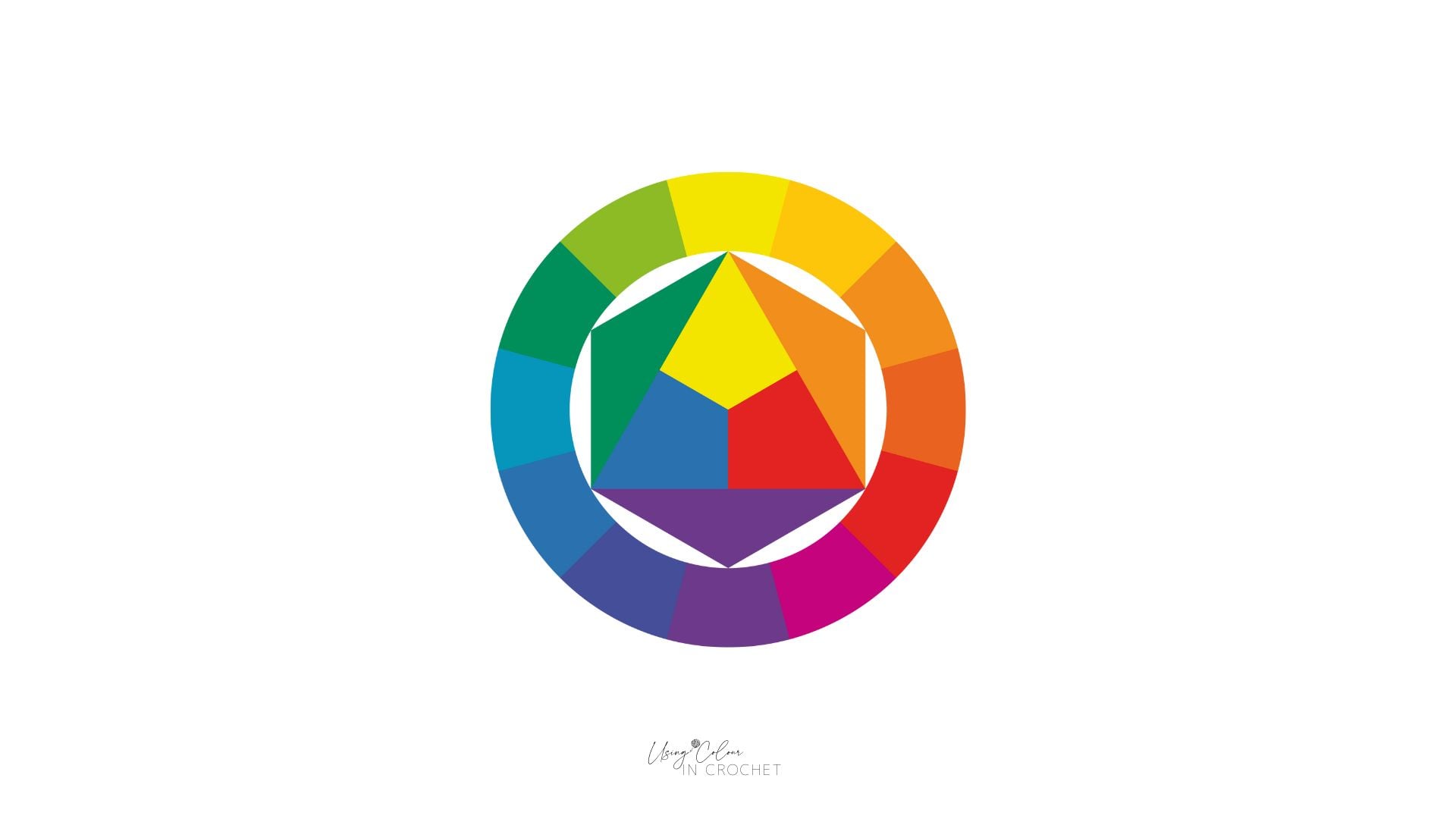
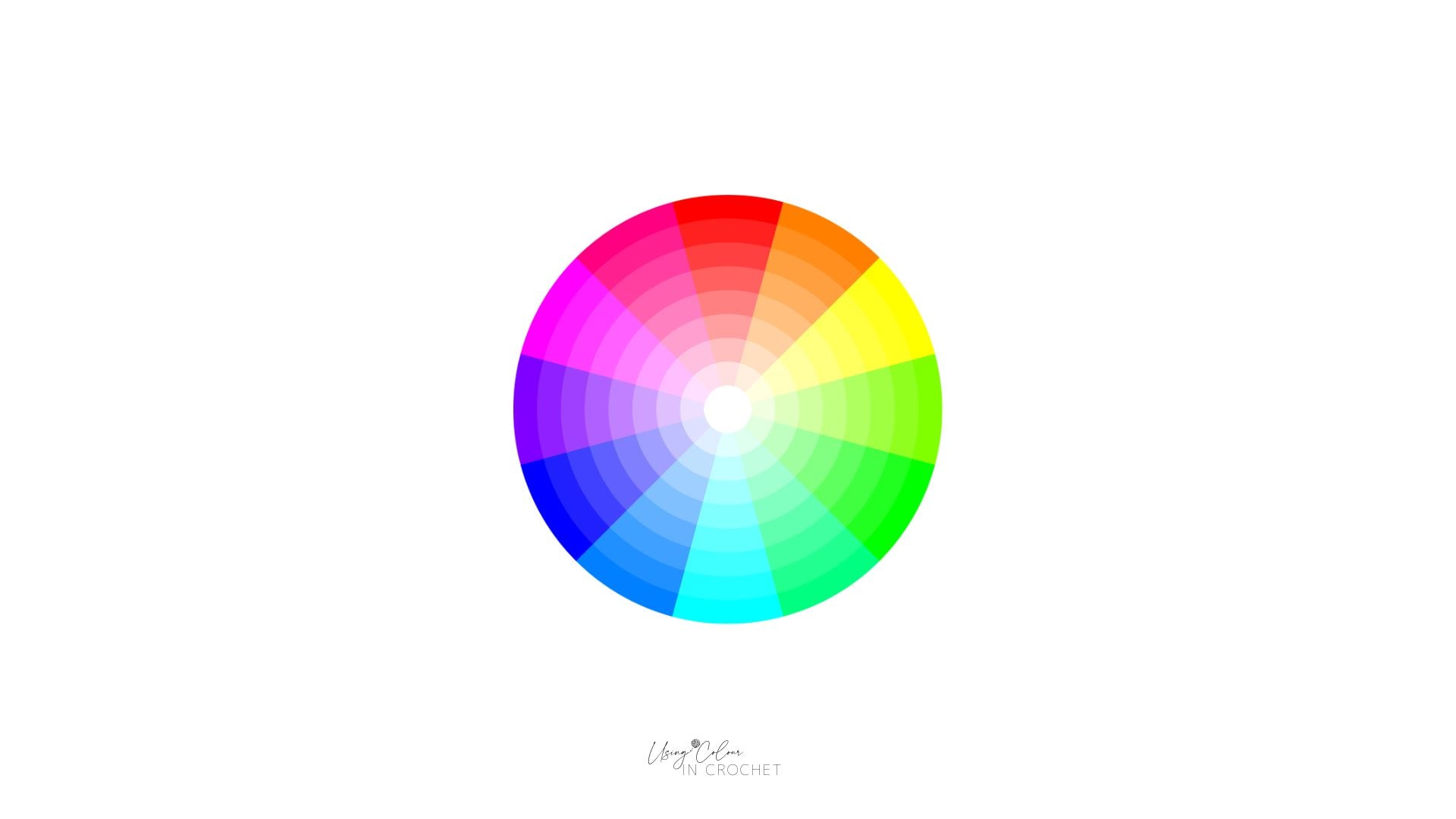
A simple colour wheel helps us do this brilliantly and this is what one can look like:
There are three sections to the colour wheel that help us to place colours together easily:
PRIMARY COLOURS – these are the three colours (red, yellow and blue) in the centre triangle.
SECONDARY COLOURS – these are the next three colours (orange, green and purple) that are in the hexagon. These are made by mixing primary colours together.
TERTIARY COLOURS – these are all the colours around the wheel that gradually blend from one to the next and are mixes of primary and secondary colours
That’s great Hannah, but how does it help me choose yarn colours?
Well, once you have an understanding of these sets of colours and the wheel you can use them to create absolutely any type of colour scheme that you can dream of!
In order to put together harmonious colour schemes we have a couple of other things to look at first – colour properties and colour harmony formulas.
Colour Properties
As you can see in the wheel it certainly doesn’t show all the colours you can imagine. We need to add a few factors in to get everything. This is when we need to explore a colours properties.
HUE – this is simply how it appears i.e. it looks green or blue (although that is often debatable in our house!).
CHROMA – this is how pure to the initial colour it is. If it has shades (black), tints (white) or tones (grey) added it will dramatically change the colour.
LIGHT – this is about how pale or saturated the colour is.
All of these aspects mean that there are hundreds of versions of the very same colour from the basic colour wheel! Just look at what that looks like:
Choosing Colour Schemes
The next blog post will cover colour schemes in more detail, but we will touch on it briefly now too, as this is what determines how you choose which colours to use in your crochet projects.
What are Colour Schemes?
Colour schemes are strategically chosen groups of colours that work harmoniously to create the right feeling and contrast to your project. There are countless different schemes you can create to get the look and feel you want.
There are lots of ways to combine colours together but following these simple steps for matching shades makes it super easy!
You might find that you naturally place these combinations together without realising it. Think about when you get dressed each day – how do you decide what colours ‘go’ together for your outfit? I bet you use one of these schemes!
Let’s take a look at them in turn and see how they work in terms of choosing yarn:
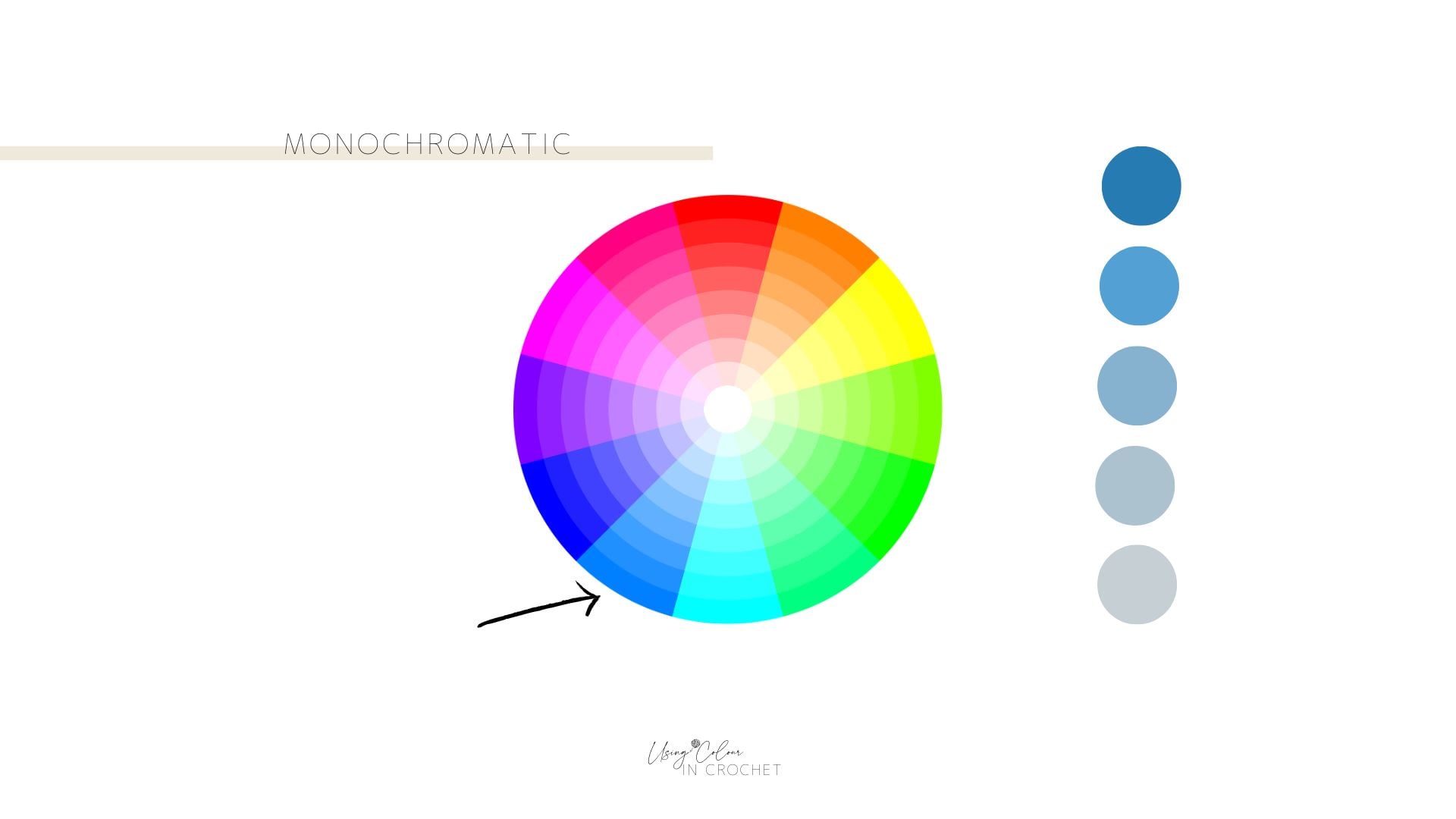
MONOCHROMATIC
Monochromatic schemes take one hue from the wheel and create a palette using different shades and tints of it by adding black, white and grey to it.
You can see an example of what it might look like to the right of the wheel.
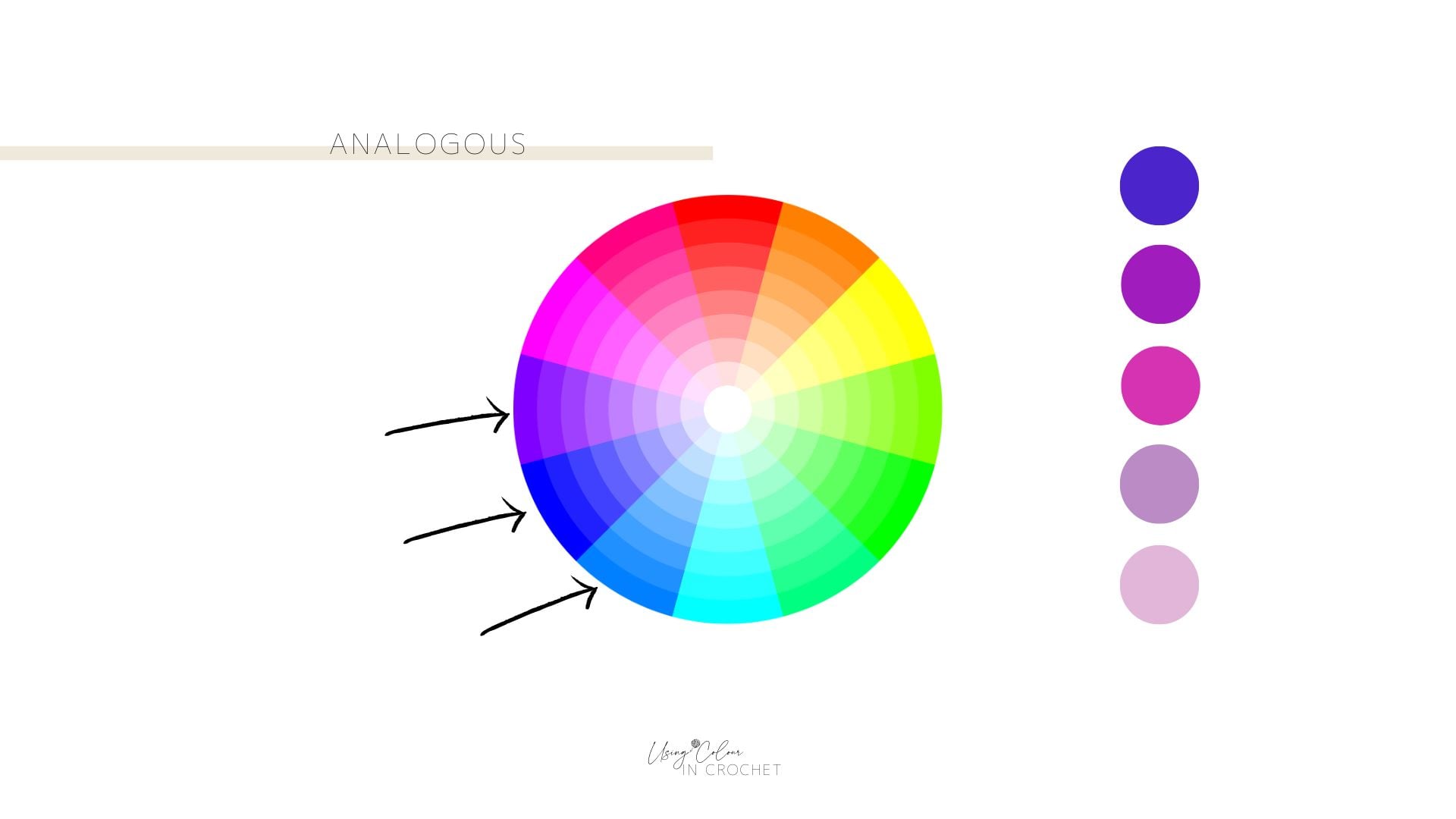
ANALOGOUS
Analogous schemes take three colours from the wheel that are adjacent to each other. You can add depth by using white with some of the colours too.
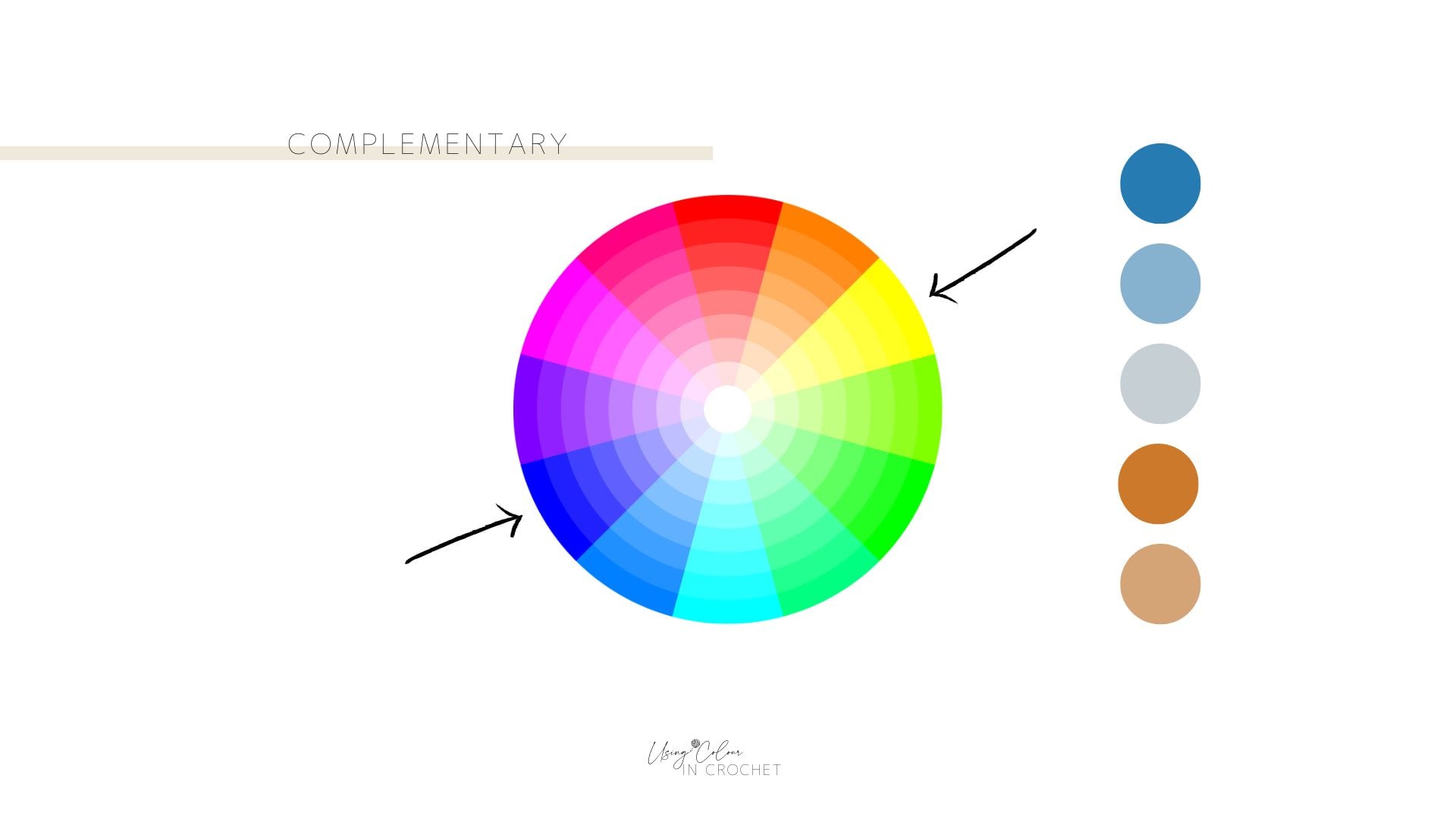
COMPLEMENTARY
Complementary schemes take colours from opposite sides of the wheel. Again, you can add interest and depth by adjusting the chroma (black, white or grey).
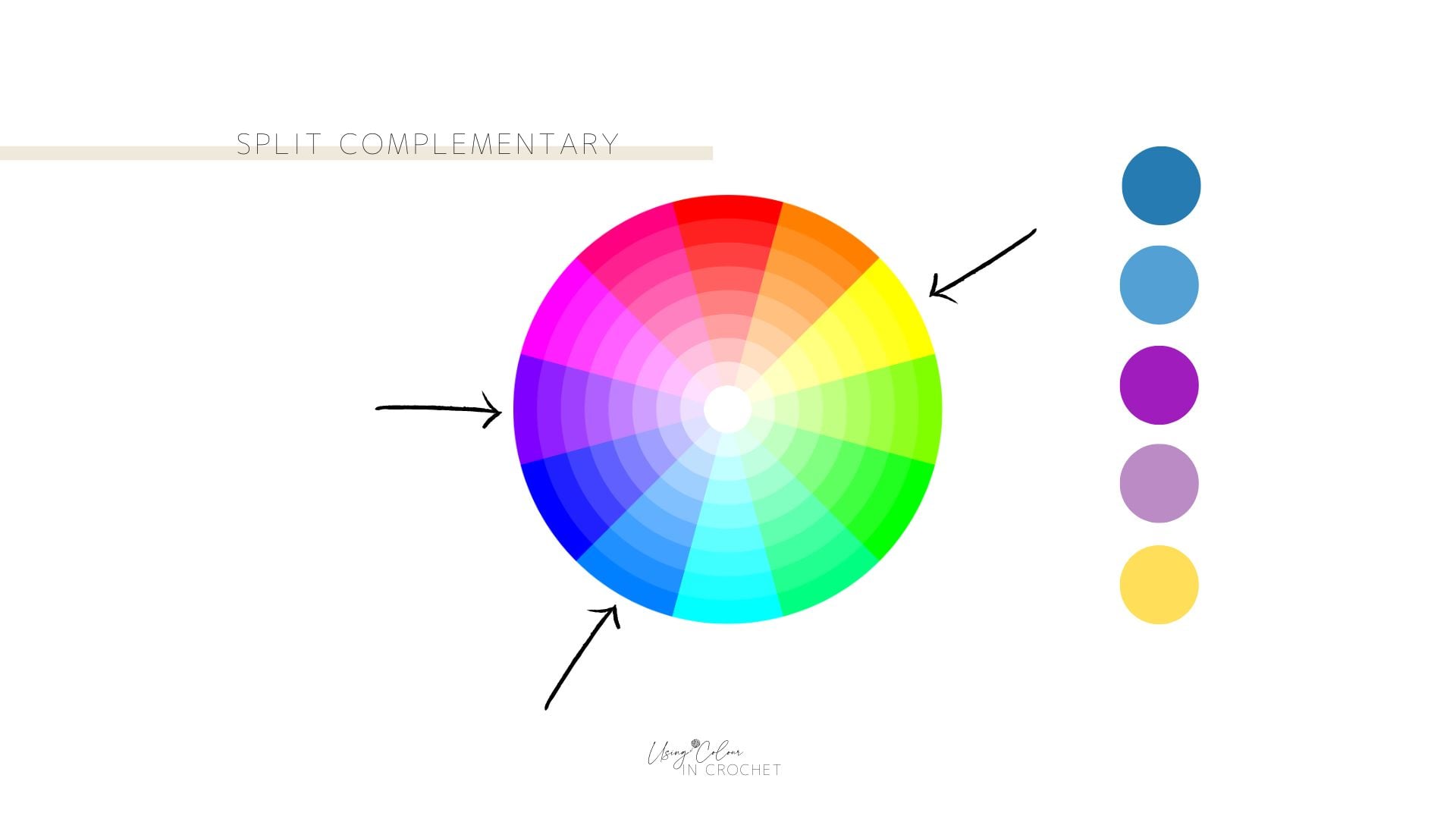
SPLIT COMPLEMENTARY
Split complementary schemes take one colour from the wheel and then use the 2 colours either side of its complementary colour.
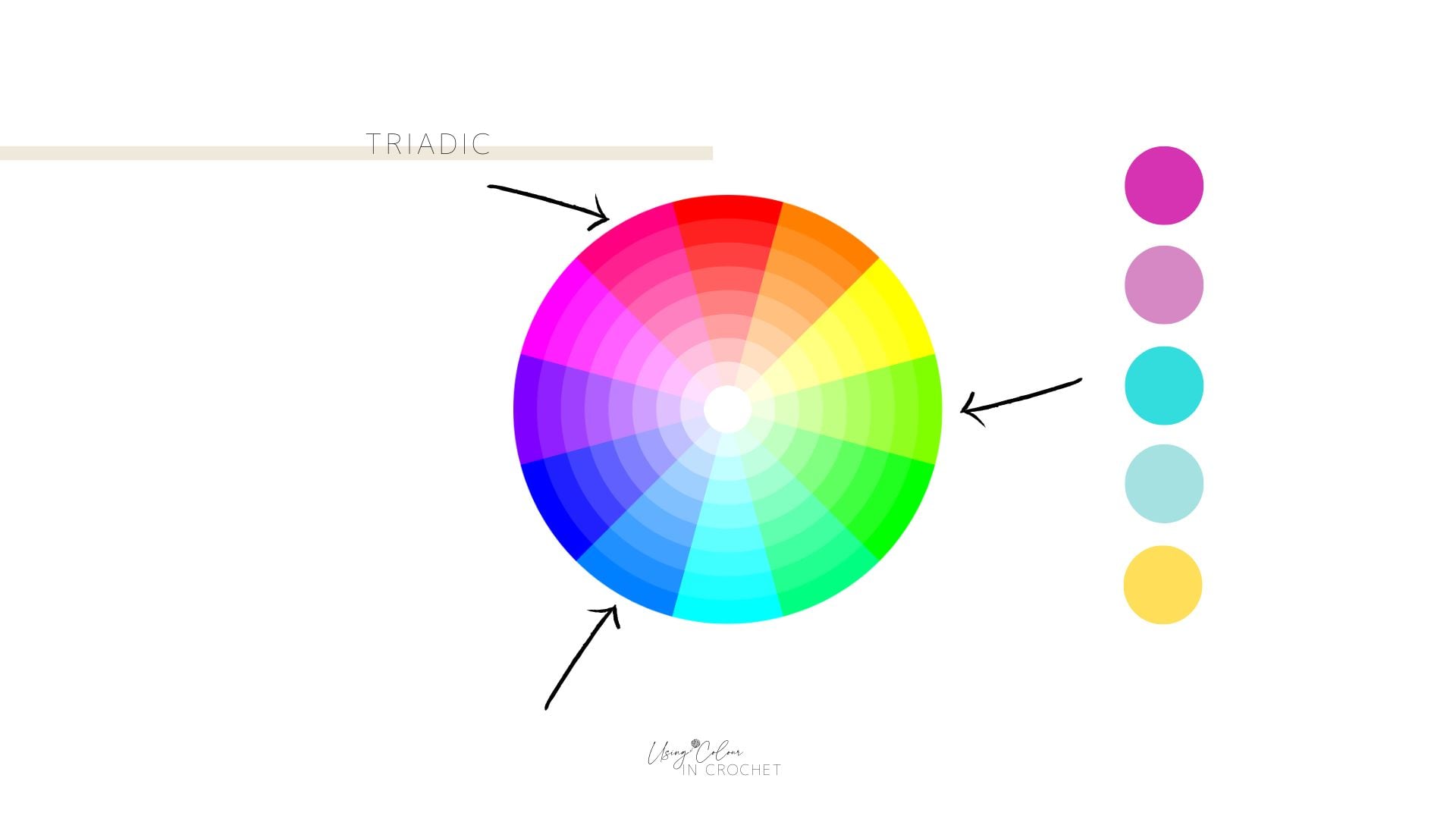
TRIADIC
Triadic schemes use three colours that are evenly spaced around the colour wheel.
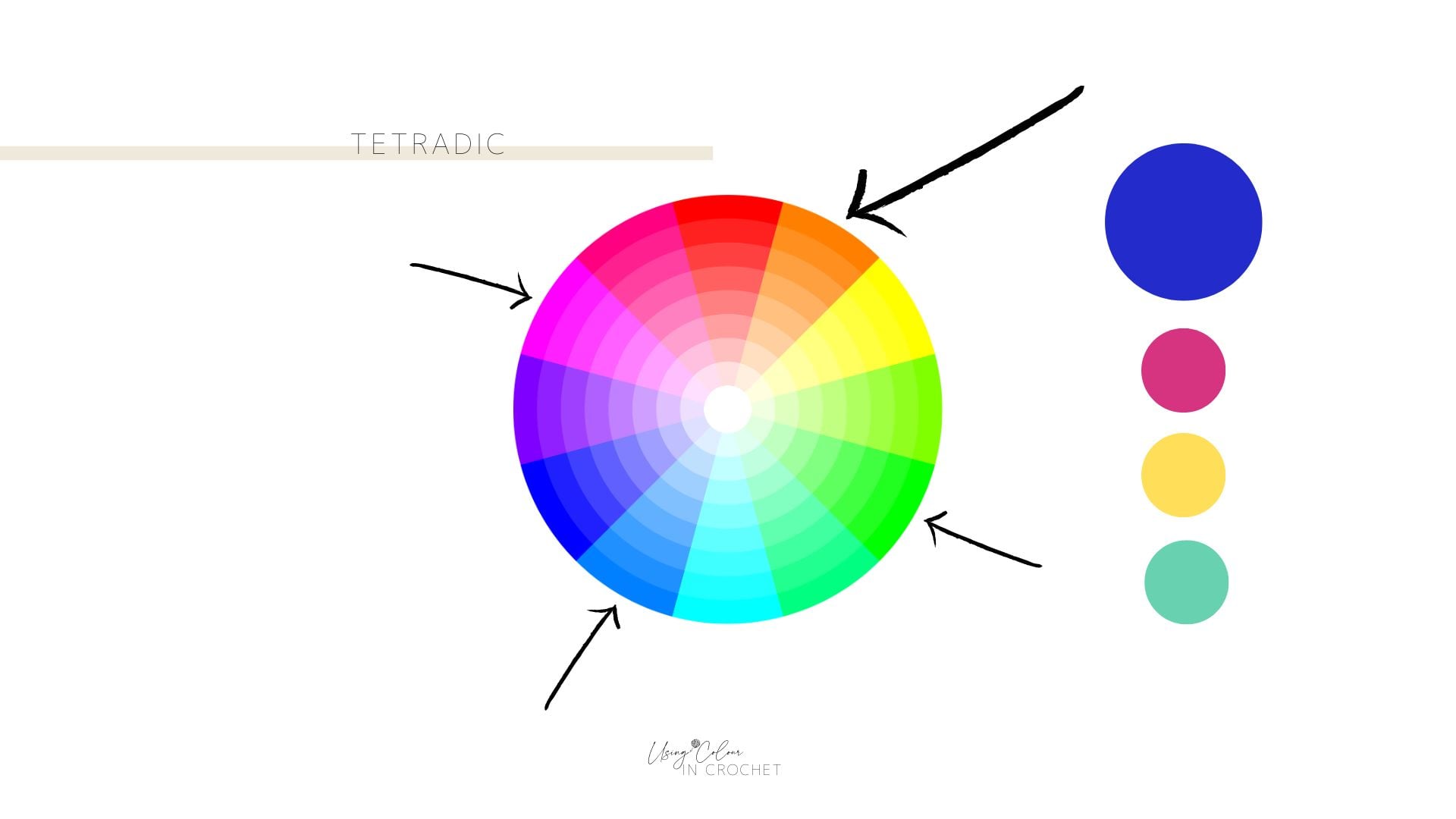
TETRADIC
Tetradic schemes take two sets of colours that are complimentary pairs and then choose one dominant colour to create balance.
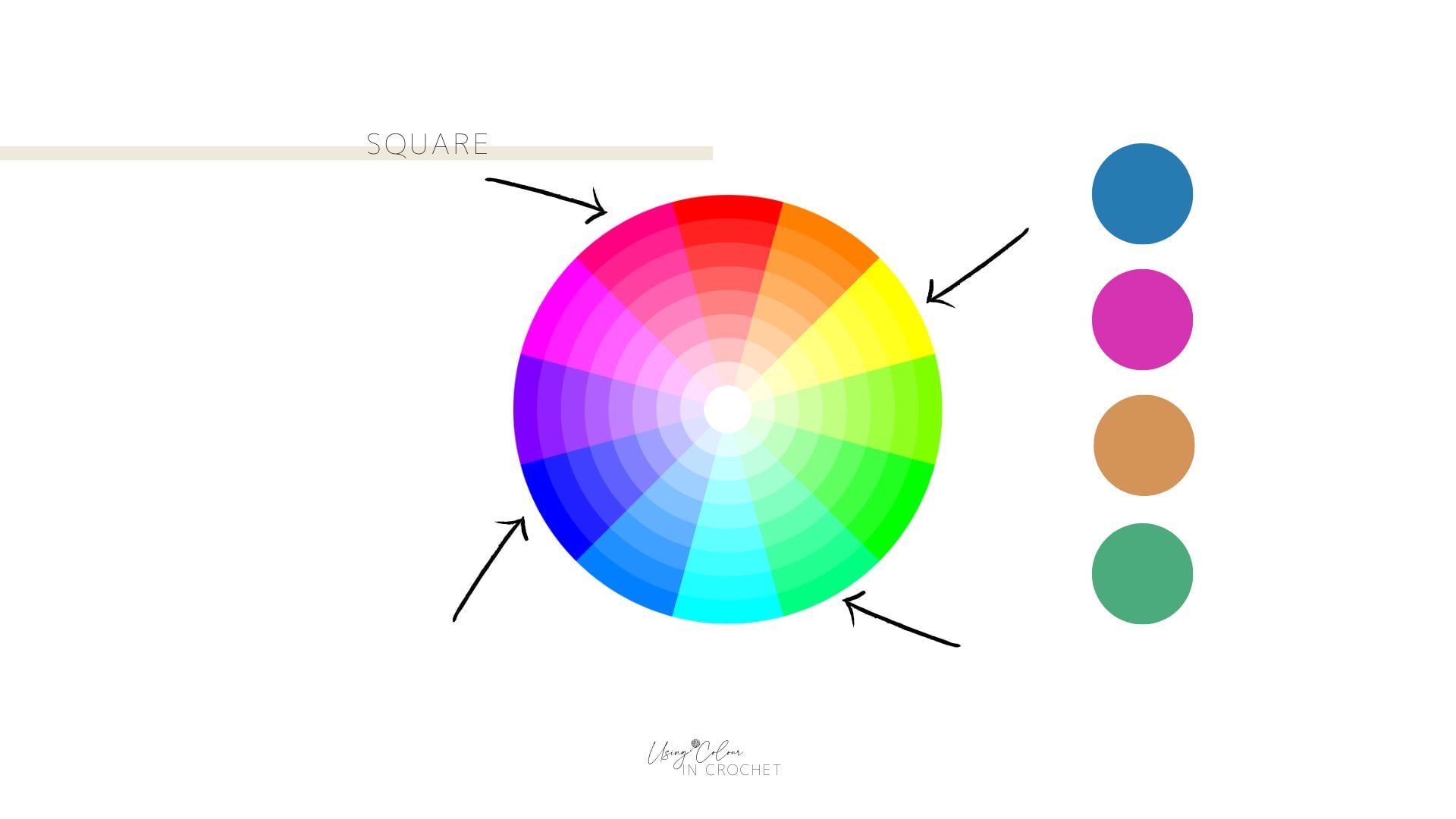
SQUARE
Square schemes work in the same way as tetradic but don’t have a dominant colour. All of the colours are uses evenly.
Next Steps in Your Crochet Colour Journey
Now that you’ve learnt all about the crochet colour wheel, let’s move on to learn how to pick your yarn out of all of these crochet colour schemes!
If you’d rather learn everything all at once, sign up to my Using Colour in Crochet Online Course which includes interactive workbooks and videos from me talking you through it all!
Get your free guide!
Subscribe to get your free guide to choosing and combining colours!
Learn Some More Crochet Techniques With Me
There are so many interesting things to learn about in the world of crochet and I’m here to help! Why not take some time to learn some crochet stitch tutorials – or how about some of these other important areas of crochet:
- Yarn Weight Chart and Guide in Crochet
- Mosaic Crochet Tutorial; What’s the difference between Overlay and Inset Mosaic
- Guide To Crochet Hook Sizes: Best Types and Chart for Beginners
- How to Make a Crochet Gauge Swatch, and Why it’s So Important
I hope you’ve enjoyed learning all about crochet colour theory with me! I really hope you’ve caught the crochet bug and I’d love to share in your crochet journey with you! You can sign up to become a member of HanJan Crochet and I’ll let you know about all the fabulous crochet adventures, offers, lives and more too!
See you there!
Join our community group!
We’ve built an amazing community always ready to help each other. Join today!